






A deep dive into what makes this plant-based yarn genuinely different — and worth adding to your craft basket
We sell a lot of wool at Chimney Sheep. Wool is our thing. Herdwick wool, specifically — that wonderfully robust, characterful fibre that comes from the fell-roaming sheep of Cumbria, practically our neighbours. So when we decided to stock yarn as well, it had to be yarn we could feel equally enthusiastic about. Something with a proper story behind it, not just something to fill a gap on a shelf.
Eucalyptus yarn passed the test - quite comfortably, actually.
Here's why.
Not All Plant Fibres Are Created Equal
There's a temptation, when shopping for eco-friendly craft materials, to assume that anything labelled "natural" or "plant-based" is automatically a good choice. It isn't always. Cotton, for instance, is entirely natural. It's also one of the thirstiest crops on earth — conventional cotton farming is notoriously water-intensive and relies heavily on pesticide. Natural, yes. Low-impact, not especially. And jute, well, I've had a bit of a worry about jute. More about that later, when I introduce our organic cotton trellis nets that are being made for us.
Eucalyptus is different on both counts. The trees grow at a remarkable pace — several metres a year in ideal conditions — on plantation land in Portugal that isn't suited to food crops, and they do it without irrigation or chemical inputs. They're also harvested rather than cleared, regenerating from the stump rather than requiring replanting from scratch. So before a single fibre has been spun, the raw material credentials are already considerably better than most.
But the more interesting part is what happens next.
A Factory That Doesn't Waste Much
Turning a tree into yarn isn't a simple process. The wood has to be broken down into a fine, workable fibre — and that transformation requires chemistry. This is where many plant-based fibres fall short. Bamboo, for instance, is often marketed as a sustainable miracle material, but converting bamboo into soft textile fibre typically uses a chemical process that isn't particularly clean, and those chemicals tend to end up somewhere they shouldn't.
Eucalyptus Lyocell — which you may also know as TENCEL™, the brand name registered by Austrian company Lenzing — uses a different approach. The wood pulp is dissolved in a solvent, spun into long, continuous fibres, and then — crucially — that solvent is captured and fed back into the system. More than 99% of it is recovered and reused in each production cycle. The technical name for this is a closed-loop process, and it means the manufacturing produces almost no chemical waste. The water usage is also substantially lower than conventional cotton production.
It's not a perfect process — almost nothing is — but it is, by any reasonable measure, one of the cleaner ways to produce a soft textile fibre. And it results in something genuinely rather beautiful.
In Your Hands
Describing what a yarn feels like is always a bit of a challenge in writing, but I'll try.
Eucalyptus yarn has a smoothness to it that is immediately noticeable. It slides off the ball differently from wool or cotton — there's a slight sheen, a lightness, and when you hold a length of it up, it falls rather than hangs. That quality — what textile people call drape — is one of its most distinctive characteristics, and it's what makes eucalyptus particularly suited to garments.
It's also notably cool against the skin, making it a good choice for warmer months or for people who run hot. And because the fibre is naturally smooth at a microscopic level, rather than having the slight scales that give wool its texture (and occasional scratchiness), eucalyptus sits very comfortably against sensitive skin. People who can't tolerate wool, or who find cotton itchy, often get on well with eucalyptus.
One practical note: because it's a plant-based fibre that takes dye in a natural way, the shade can vary slightly between production batches. This is worth knowing before you start a large project — buy enough to finish in one purchase, rather than assuming a top-up order will be a perfect match. It usually is, but "usually" isn't good enough when you're halfway through a cardigan.
What It's Good For
Lightweight knitted or crocheted garments are where eucalyptus yarn really shines. Tops, tunics, summer cardigans, dresses — anything that benefits from a bit of movement and breathability. It blocks well, holding its shape after washing with a gentle hand wash, and the slight sheen gives finished items an elevated quality that belies the effort involved.
Shawls and wraps are another strong suit. Eucalyptus yarn has enough body to drape beautifully when blocked across the shoulders, but none of the warmth-trapping bulk of wool. For anyone who wants something to throw on in spring or early autumn — warm enough to be useful, light enough not to be stifling — it's a rather good option.
Baby items are worth a mention too. The softness and hypoallergenic properties make it suitable for skin-sensitive new arrivals, and the fact that it's entirely plant-based and compostable at end of life appeals to parents who are thinking carefully about what they bring into the house.
And finally — a slightly unexpected suggestion — eucalyptus yarn makes excellent gift wrap. A ball of Sandford White or Silverton Grey tied into a bow around a present looks considerably more considered than synthetic ribbon. I use it to wrap the Surprisingly Good Soap, and often receive comments on how pretty it looks.

Our Range
We stock Jolly Good Yarn 100% Eucalyptus Yarn in ten colours, sold in 100g balls with approximately 150m per ball — enough for a good-sized shawl or a couple of smaller pieces. The current palette runs from neutrals through to stronger tones:
- Sandford White — clean and cool; a useful base for any wardrobe
- Silverton Grey — soft and neutral; works with almost everything
- Heavitree Black — crisp and classic
- Pinhay Sage — a muted, dusty green with a pleasingly understated quality
- Sherwood Green — deeper and richer; a proper botanical green
- Riverton Teal — blue-green; good for both garments and accessories
- Slapton Yellow — warm and cheerful without being aggressive about it
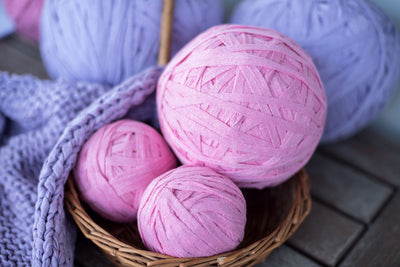
- Hartland Pink — a stronger pink for those who like a bit of colour
- Yeoford Pink — softer and more muted; elegant rather than bold
- Woodbury Copper — a warm russet that works particularly well in autumn
All colours are available on the product page. And if you'd like to explore the broader Jolly Good Yarn range — including T-shirt yarn, recycled cotton macrame cord, and recycled bottle yarn — have a look at our sister site, www.jollygoodyarn.com.
The End-of-Life Bit
Here's something that doesn't get mentioned enough about most yarns: where do they go when you're done with them? Acrylic goes to landfill, where it sits for a very long time. Most blended yarns are difficult to recycle.
Eucalyptus Lyocell is home compostable. Put a worn-out eucalyptus dishcloth or a discarded swatch on the compost heap and it will actually break down.
We sell wool because we believe in the closed loop — the idea that materials should cycle through use and return to the earth rather than pile up in the bin. Eucalyptus yarn fits that philosophy pleasingly well.
See the full eucalyptus yarn colour range →
Eucalyptus yarn is part of our Project & Craft Supplies range, in partnership with Jolly Good Yarn. Ten percent of Jolly Good Yarn profits go to Buy Land Plant Trees CIC — our community interest company rewilding land in Cumbria.