







I'll be honest with you: I love worms, but I don't much fancy handling them. I tried a proper worm farm once — the sort you keep in a box and fuss over — and between the bran and the bedding and the syphoning off of the "tea", I decided the wigglers and I were better off keeping a respectful distance. So the terracotta worm composter is very much my sort of thing. You bury it, you feed it your kitchen scraps, and the worms turn up of their own accord and get on with it. No box, no bran, no faffing.
But there's a lovely bit that often gets overlooked. This isn't just a tidy way to deal with peelings — it's a way of feeding your garden from the inside out. The worms and the liquid from the decomposition process go straight to work on the soil around the composter, which means the plants in your flower borders and veg beds are the ones that benefit.
Worms are your unpaid gardeners

First, a quick worm clarification, because it catches everyone out: the worms that actually break down your kitchen scraps are composting worms — the small, reddish brandling or "tiger" worms (Eisenia fetida, to be precise) that live on decaying matter. They're a different sort from the bigger, paler earthworms most of us picture nosing through the soil (the common lob worm, Lumbricus terrestris, and its relatives). A buried composter is clever because it makes use of both — composting worms pile into the food waste and process it, while the earthworms already living in your bed carry the goodness out into the wider soil.
And those soil earthworms really do earn their keep. Charles Darwin spent the last years of his life writing a whole book about earthworms, having worked out that they quietly run the whole show underground. Modern science agrees: a big review in Nature Scientific Reports pulled together decades of studies and found that simply having earthworms active in the soil increases crop yields by around 25% on average, and above-ground growth by about 23% (van Groenigen et al., 2014).
That's a remarkable figure for something you don't have to buy, plug in or even think about. And the researchers were clear about why it happens: worms unlock nitrogen that's otherwise locked away in decaying matter and soil, releasing it in a form plants can use.
When you bury a terracotta composter and fill it with scraps, you're basically laying on a worm banquet in the middle of your bed. The holes in the base let the worms come and go as they please — in for a feed, out again to trundle through your soil, aerating it, opening up little channels for water and roots, and (there's no delicate way to put this) doing their little worm poos as they go.
What's actually in a worm cast
Those "worm poos" — casts — are pure gardener's gold. A meta-analysis in Geoderma compared worm casts with the surrounding soil and found the casts were significantly richer in nitrogen, phosphorus and organic carbon (van Groenigen et al., 2019). So every time a worm passes through your bed, it's leaving behind little parcels of slow-release fertiliser, distributed exactly where the roots are.
The compost that builds up inside the pot is the work of those composting worms, and it's every bit as good — it even has its own name: vermicompost. A meta-analysis in Agronomy for Sustainable Development looked at study after study and found it delivered average increases of 26% in harvestable yield, along with big jumps in root and shoot growth (Blouin et al., 2019). A separate review found vermicompost raised the available nitrogen and phosphorus in growing media dramatically, and improved the soil's ability to hold water by around a quarter (Wang et al., 2022) — which matters a great deal on a dry summer bed.
The "compost tea" — and why burying it is the clever bit
Now, the liquid. When kitchen scraps break down, they release a nutrient-rich liquid — the stuff people call "compost tea" or "worm tea". Most worm farms are designed so you collect this in a tray at the bottom and then decant it, dilute it and water it on. Which is all very well if you enjoy that sort of thing.
Here's the thing about our terracotta composter: because it's a small composter that sits buried in the bed, the tea doesn't need collecting at all. It seeps out two ways — down through the holes in the base, and outwards through the porous terracotta walls themselves, in just the way a terracotta olla weeps water into the soil around it. That's precisely why you bury it in direct contact with the earth, with no worm bedding or lining to get in the way: the whole pot becomes a slow, gentle feeder, delivering the liquid straight to the root zone all around it. You get all the benefit and none of the buckets.
And burying it quietly solves a problem the researchers have flagged. Studies on collected worm tea show it's good stuff — one trial on maize found the leachate stimulated growth nicely — but they also found that undiluted it's too strong and can actually set young plants back, so it needs watering down before use (García-Gómez et al., 2008). With the buried composter, the surrounding soil moisture does that dilution for you, gradually and gently, so the feeding is steady rather than a sudden hit. Simple but effective — which, as regular readers will know, is exactly the sort of thing we like.
Where to put it for the best results
Because the whole system feeds the soil immediately around it, placement is everything if fertilising your beds is your goal:
- Pop it in the middle of a veg bed where you're growing hungry feeders — courgettes, squash, tomatoes, brassicas — and let the tea and casts work their way out to the roots.
- Tuck one into a flower border among perennials that appreciate a rich, moisture-retentive soil.
- Run two at once. Loads of our customers do this — feed one while the other rots down, then toggle between them. You'll be pleasantly surprised how fast a bucketful of scraps disappears once the worms find it.
The composter itself is made from natural terracotta by our friends in Tunisia, the same clever folk who make our ollas. The clay is breathable, so air circulates and the worms stay comfortable; it wicks away excess moisture so things don't turn soggy and smelly; and at the very end of its long life it simply crumbles back into the soil it came from. No plastic, no imported worms shipped halfway round the world — just the local wigglers you already have, invited in for supper.
And a word for the planet
I'm sure you know this already but food waste chucked in the bin rots without oxygen and produces methane, a greenhouse gas far more potent than carbon dioxide over the short term. Composting your scraps instead — and letting the worms recycle them into fertiliser for your own garden — sidesteps all of that. Good for your beds, good for your veg, good for the climate.
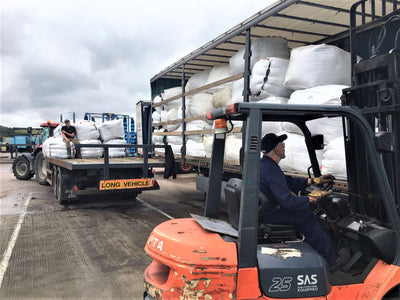
Oh, and one last thing: we pack these in a lot of wool to keep them safe in transit. Don't bin it — use it as mulch, stuff a cushion with it, or leave a bit out for the birds to line their nests. Waste not, want not.
Happy composting!