






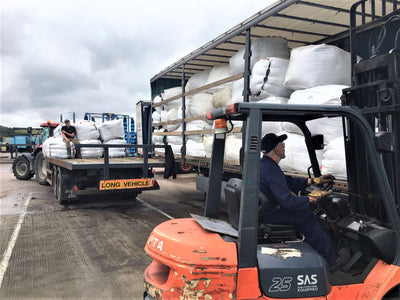


A couple of years ago, I was sent a photo by the company that makes our ollas. Would we want to try these:

This was my introduction to worm composters. I will be completely honest with you: I had never used one before and didn't really know much about them. However it looked interesting and I was keen to give it a go. The sample was buried to try it out, and a pallet-load was ordered.
There has been such a lot of interest in the in-ground worm composter, and in answering everyone's questions I have learned a lot more about vermicompost. Here are some of the questions and the replies:
Does it attract rats?
Rats can't get in, the lid is too heavy.
My garden is very sandy — I don't appear to have many worms. Would any I do have be attracted to this once it has veg waste in it?
Best thing is to introduce a spadeful of worms from a nearby compost heap to help them get started. Once introduced, they will carry on self-replicating. To use a Derek Gow term, they are fecund creatures.
Why not just dig a hole in the garden and put the scraps in? Amounts to much the same thing, only the scraps would disappear quicker directly in the soil.
If you bury food waste it tends to decompose anaerobically and it will still produce methane. The terracotta pot provides a space for the waste to be broken down aerobically by bacteria; then the worms come in and eat the bacteria, then distribute fertiliser around the garden. They also aerate it in the process. And, it's sad for the hard-working worms, but they are a food source for a wide range of wildlife so they increase biodiversity in the garden too.
Can it be left in the garden over winter? Will it crack with frost?
As it's in the soil it should be fine unless there's a really hard frost. The rim that sticks up above the level of the soil could get frosted but I cover mine with a layer of wool, then a board over the felt, and keep the lid somewhere safe.
£60! Hahaha!
They are lovely pots, handmade, plus heavy for us to send — they come with 3 kilos of Herdwick wool into the bargain. But I agree they're not cheap so there are ones you can make yourself if you search online.
What size are they? Just need to know how deep the bed needs to be to take one.
They are 30cm deep, and 30cm wide.
Bit of a pain having to dig it up to get the compost out though?
Mostly, the nutrients are distributed by the worms. Eventually the worm casts build up but you just scoop them out with a trowel or by hand. The idea isn't so much to make compost, but to dispose of vegetable waste and deliver fertiliser and moisture directly to plant roots.
It's cheaper to buy shop compost!
The purpose of the terracotta one is more for disposing of your household vegetable waste and reducing methane, rather than producing compost. It's also an excellent way of dispersing fertiliser through your garden from the inside.
The result?
The result is worms digesting the waste (technically, they're digesting the bacteria that decompose the waste) then they distribute it around the garden, fertilising it from the inside.
Food waste in UK is collected and composted.
Not everywhere. Sadly not in Cumbria. And this is a way of utilising food waste in a way that benefits the garden and the ecosystem.
How does it feed the whole bed if it's stuck in one place?
The worms deliver the nutrients from the composter to other parts of the bed. The red wigglers get so far then the earthworms and other invertebrates spread it further.
Does this work in a raised bed too? Will there be enough worms?
Yes it works in a raised bed and the worms should find it on their own if the soil is right, but it does help to add some from another nearby compost heap to get it started.
I really want one of these but just haven't got that money.
Online there are suggestions for how to make your own DIY in-ground worm composter.
I don't have any sort of composting methods in my garden as I'm terrified of the snakes they could attract. Has anyone found snakes are attracted to this? Or rats?
The lid is quite heavy so rats and snakes can't get in. Snakes wouldn't be attracted to this type of composter; they like hot composters which keep them nice and warm.
How long does a full composter take to break down?
It varies a little but it can go from full to empty within a week.
And it still produces methane.
Aerobic composting (which vermicomposting is) produces virtually no methane.
Would just throwing the materials on the soil do the same job?
The worms are at risk of being eaten by predators when they are above ground so it works better with the vegetable peelings underground in the worm composter.
I think these are brilliant, but surely the waste in them still produces methane as it decomposes?
The process produces carbon dioxide instead of methane (which is a much worse greenhouse gas). It produces about one eighth of the amount of greenhouse gases by composting with worms versus putting it in landfill.
Keep 'em coming, those questions. Some of them provoke interesting chats.
I thought you might like to see some of the reviews too, and if you've written one of these then THANK YOU. I really appreciate all the positive reviews and nice kind feedback.
Great idea and product
I've put this amongst my flower beds and am using it for my plant-based kitchen scraps. I particularly like the fact that it is buried as this dissipates any smell and means it doesn't attract vermin. Simple but ingenious concept.
Beautiful Composter
This composter is beautifully made as well as functional. It also came packaged in wool which I LOVE and have used in the garden and in some handmade items. Sustainable and gorgeous.
Worm composter
I bought a worm composter last year and put it in my only (walled) flower bed next to honeysuckle and climbing rose. It's taken a surprising amount of veg waste, and my honeysuckle and roses have never looked better!
Works well, looks good
I now have 2 of these and use them in rotation, allowing one to rot for a while I fill up the other and then scooping out what's left. They work well and even look quite attractive.
Worm Composter News
I just wanted to give some exciting feedback: since putting in the two terracotta worm composters earlier this year, my garden now has a mole and, even more excitingly, water shrews! From the way they've been tunnelling and burrowing around the flowerbeds, I can't help but think it's related to good soil invertebrate abundance, likely improved significantly by the composters.