







Wool has got an image of being a bit, well, woolly. Fluffy. Funny sheep puns and all that. We love our sheep puns. (Don't ewe?) But more research is coming out that shows just how functional it is in many ways. It's more accurate to call it a technical fibre really. It has a range of properties that make it particularly good at certain jobs, and much better than its over-processed synthetic counterparts.
It felts
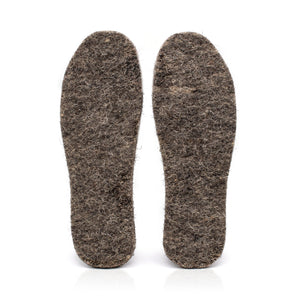
The wool fibre has tiny barbs on it, so when it is put through a bank of barbed needles, the fibres mesh together to make a robust non-woven fabric: felt. It's one of the oldest textiles known to humankind. Felt has great shock-absorbing properties, which makes it perfect for our Snug Feet insoles.
It's springy
Wool compresses and bounces back to shape readily, which makes it ideal for the Chimney Sheep. It squashes into the uneven contours of the inside of a chimney, and keeps that springiness so it holds itself in place for many years.
It traps air
Its air-trapping properties make it well suited to being a sustainable insulation material. Some wool insulation products on the market have plastic fibre mixed in to give them loft. The insulation we sell is made by Isolena, who also turn our Herdwick wool into moth-proofed felt. Using the same simple-but-genius problem solving that cracked the moth problem, Alex developed a way of layering the wool fibres as they are needle-felted, so that no extra lofting agents are needed and the insulation stays lofty throughout its lifetime.
It handles moisture
Wool is hygroscopic, meaning it can hold surprising amounts of water without feeling wet. That moisture is then released again in drier conditions. This works well in a range of applications:
- Insulation: it helps a building, especially an older one, to breathe. It absorbs damp from the air, then lets it evaporate away when conditions are drier.
- Insoles: they can hold a lot of sweat without getting icky.
- Mulch mats: they hold plenty of moisture and help keep plants hydrated.
- Hessian cushions and door draught excluders: these make brilliant moisture absorbers. The loose weave of the coffee sacks lets plenty of moist air in, and then it locks onto the wool fibres. They're ideal for getting moisture out of damp cars. Just dry the cushion out on the radiator, then pop it back in the car.
Wool can absorb up to a third of its weight in moisture without feeling wet. So a door draught excluder with a kilo of wool in it will absorb around 300g of water at a time, and can be dried out and reused endlessly.
It warms up when it gets damp
Here's a strange one. When wool absorbs moisture, it gives off heat. Water molecules bond with the chemical groups inside the fibre, and that bonding releases energy, a process called the heat of sorption. All fibres do it a little bit, but wool does it far more than the rest, and polyester barely does it at all. Woolmark quote a figure that a kilo of dry wool soaking up 35% of its weight in moisture gives off about as much heat as an electric blanket running for eight hours.
That's why a wool jumper still feels warm on a drizzly Cumbrian walk, and why your Snug Feet insoles don't go cold and clammy when your feet get sweaty. It's also one more reason wool insulation copes so well with our damp climate: as it takes on moisture on a cold, wet night, it's giving off a little warmth at the same time.
It cleans the air
Wool absorbs VOCs: volatile organic compounds. These are the gases given off by all sorts of things in our homes, from MDF and chipboard furniture to fresh paint, glue, cleaning sprays, air fresheners and nail varnish. The best known is formaldehyde, which seeps out of the glues used in pressed-wood furniture and is classed as a carcinogen. Given that most of us spend the vast majority of our time indoors, what's floating about in the air at home matters.
Researchers at Bangor University put wool through its paces with four different VOCs: formaldehyde, toluene (found in paint thinners), limonene (that citrusy smell in a lot of cleaning products) and dodecane. Wool absorbed all of them, and the chemicals became bound into the structure of the fibres.
So how does it work? Wool is made of keratin, a protein, and the building blocks of that protein have chemically reactive bits sticking off them. These grab hold of passing VOC molecules. In one study, wool exposed to formaldehyde gas soaked up nearly 5% of its own weight in it. When the wool was then moved into clean air, some of the formaldehyde came back out, but about 2.9% of the wool's weight stayed put, chemically bonded to the fibre for good. That means wool works as a buffer: it mops up pollutants when levels rise and keeps them low.
There was another interesting finding. The researchers noticed that the more darkly pigmented the wool, the more formaldehyde it tended to absorb. Our Herdwick wasn't one of the breeds tested, but as one of the darkest, most characterful wools in Britain, it makes us rather hopeful!
What does this mean for our products? Quite simply, the more wool you have in your home, the more it can absorb. Wool insulation is a big mass of fibre quietly working away in your loft or walls, and because Isolena's insulation has no plastic binder, it isn't adding any VOCs of its own. Wool rugs, door draught excluders, cushions and even a Chimney Sheep up the flue are all bits of wool doing their bit for the air in your home.
It stays clean
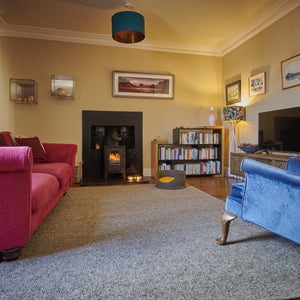
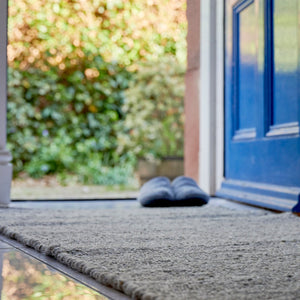
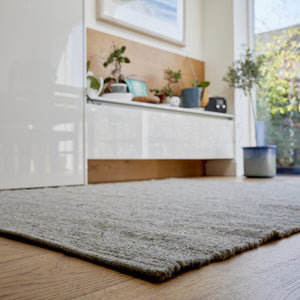
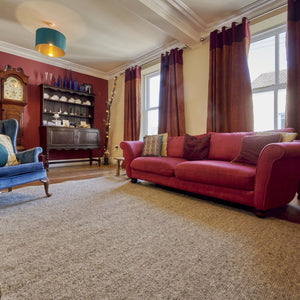
We'll be honest: wool isn't self-cleaning in the sense that it does the housework for you. But it is remarkably good at resisting dirt, stains and smells, which means you need to clean it far less often.
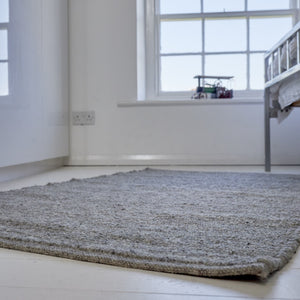
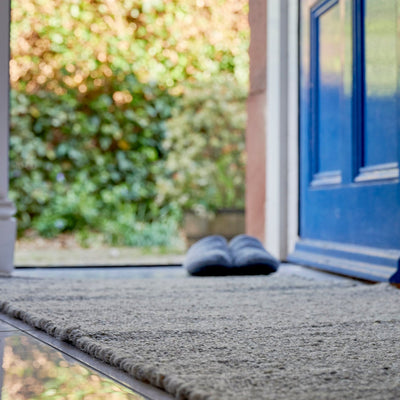
Under a microscope, a wool fibre is covered in tiny overlapping scales, a bit like roof tiles or a pine cone. These scales have a thin, water-repellent outer layer. When you spill something on a wool rug, the liquid tends to sit on top for a moment rather than soaking straight in, which gives you a window to blot it up. Dirt and dust also find it hard to stick to the scales, so they sit high up in the pile and come out easily when you vacuum or give the rug a good shake. Raw wool also contains lanolin, a natural wax that adds to that resistance, though much of it is washed out during processing, so it's mostly the fibre's own structure doing the work.
Wool also doesn't build up static the way synthetic fibres do. A static-charged nylon rug acts like a magnet for dust and fluff. A wool one doesn't.
Then there are smells. Wool locks odour molecules away deep inside the fibre, in a region packed with sulphur-rich proteins, and keeps them there until it's washed or aired. Research in New Zealand found wool fabric held onto two-thirds less body odour than polyester. That's why a wool jumper can be worn for days without whiffing, and it's good news for our insoles too.
All of this makes wool rugs a low-maintenance choice. A few care tips to keep yours looking good for years:
- Vacuum regularly to lift the loose dirt sitting on the surface before it gets ground in.
- Blot spills straight away with a clean cloth and cool water. Don't rub, and never use hot water. Remember what we said about felting? Heat, water and scrubbing are exactly how felt is made, so you don't want to do it to your rug by accident!
- Give it some fresh air. Hang your rug outside on a dry, breezy day. Wool releases trapped smells and moisture readily, so a good airing does wonders.
- Skip the chemical stain treatments. Wool's natural resistance means you don't need them.

It resists fire
This one matters a lot to us, given that our best-known product lives up a chimney. Wool is naturally flame resistant, without any added chemical flame retardants. It needs a temperature of 570–600°C before it will ignite. Cotton can catch at around 255°C, which is a temperature your oven can reach.
Wool also needs more oxygen to keep burning than there is in normal air. Scientists measure this with something called the Limiting Oxygen Index: wool's is about 25%, and the air around us is about 21% oxygen. So once you take the flame away, wool tends to put itself out. When it does burn, it chars rather than melting, so it doesn't drip or stick to skin the way nylon and polyester do, and it gives off less smoke and toxic gas than synthetics.
That's reassuring to know about anything sitting near a fireplace. But it doesn't mean you can light a fire with your Chimney Sheep still in place. Please don't! Always take it out before you light the fire or stove, and hang the reminder tag somewhere you'll see it.
It goes back to the earth
At the end of its long life, wool biodegrades. Buried in warm, moist soil, it can break down in as little as three to four months, although it varies with the soil and conditions. As it does, it releases nitrogen, sulphur and carbon back into the soil, where plants can use them. It works as a slow-release fertiliser, and one study found ground-up wool carpet boosted grass growth by between 24% and 82%.
This is the secret behind our mulch mats. They keep weeds down and hold water while your plants get established, then they quietly break down and feed the soil. No plastic sheeting to pull up and throw away.
Compare that with synthetic fibres, which can hang around for decades and break down into microplastics that end up in our rivers and seas.
It's been to space!
Yes, really. A New Zealand company called Lanaco developed a wool-based air filter called Helix, originally for face masks. In 2017 they had a call out of the blue from a contractor working for NASA, who were looking for a way to make the emergency breathing masks astronauts wear during a fire last longer.
The problem with a fire in a spacecraft is that you can't open a window. The air fills with tiny hot particles and water droplets from putting the fire out. Synthetic filters tend to have quite low melting points and struggle with all that moisture. Wool resists heat and handles moisture brilliantly, which, as you'll know by now, is exactly what it's good at.
NASA chose Lanaco's wool filter in 2019 for the emergency breathing system on the Orion spacecraft, part of the Artemis programme to take people back to the Moon. It flew on the uncrewed Artemis I mission, which travelled 1.4 million miles around the Moon and back before splashing down in December 2022. Lanaco even breed their own sheep for the job.
So a tiny bit of wool has been further from home than any human has travelled in over 50 years. Not bad for a fibre with a woolly reputation.
More than a sustainable swap
So wool products aren't just sustainable alternatives to mainstream petrochemical-based products. They work brilliantly in their own right. Wool insulates, cushions, breathes, warms, cleans the air, resists fire and stains, and then goes back into the soil when it's done. Nature had this technical fibre sorted long before the labs got involved.

Sources:
- Bangor University: Absorption of VOCs by different wool types (Green Materials, 2016)
- Mansour et al.: Absorption of formaldehyde in wool (PDF)
- British Wool: How wool interiors can help clean the air
- Woolmark: Fibre structure
- Woolmark: Wool reduces body odour
- Woolmark: Wool is fire resistant (PDF)
- Woolmark: Wool is breathable, including the electric blanket figure (PDF)
- Woolmark: Wool is 100% biodegradable (PDF)
- NZ Herald: Lanaco's wool filters to be used on NASA mission to the moon
- Tech Briefs / NASA Spinoff: Wool mask used to fight fires in space
- IWTO via Fibershed: The Future is Wool: NASA